Vitamin B12 is not made by plants or animals, but by microbes that blanket the earth. In today’s sanitized, modern world, the water supply is commonly chlorinated to kill off any bacteria. So, while we don’t get much B12 in the water anymore, we don’t get much cholera, either, which is a good thing!
Why Vitamin B12 Is Important
Though it may take years for deficiency to develop in those starting out with adequate stores of vitamin B12, the results of B12 deficiency may include a magnitude of devastating physical and psychiatric symptoms, including death.
Newborn infants of mothers who eat a plant-based diet and fail to supplement may develop deficiency much more rapidly—and with disastrous results. Getting enough vitamin B12 is absolutely non-negotiable for those centering their diets around plant-based foods.
How Much Vitamin B12 Do We Need?
I recommend:
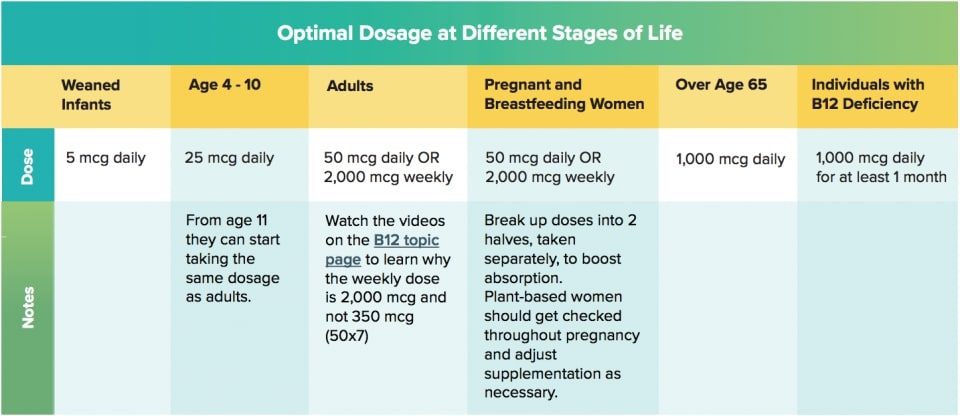
- at least 2,000 mcg (µg) cyanocobalamin once each week, ideally as a chewable, sublingual, or liquid supplement taken on an empty stomach
- or at least 50 mcg daily of supplemental cyanocobalamin
- or a serving of B12-fortified foods three times a day, each containing at least 190 percent of the Daily Value listed on the nutrition facts label
Those over 65 years of age should take at least 1,000 mcg (µg) cyanocobalamin every day.
And, here’s a tip: If you’re experiencing deficiency symptoms, the best test is a urine MMA—not serum B12 level).
How much vitamin B12 should be taken at different stages of life? Check out my videos The Optimal Vitamin B12 Dosage for Adults and The Optimal Vitamin B12 Dosage for Kids, Pregnancy, and Seniors which go into detail. This chart may be useful as an overview:
What Are The Symptoms of Vitamin B12 Deficiency?
As I elaborate on in my video The Symptoms of Vitamin B12 Deficiency, these include:
- Abdominal distention
- Chronic diarrhea
- Shortness of breath
- Swollen, red, painful feet
- Skin darkening
- Bilateral useless hand syndrome
- Numbness and tingling in the hands and feet
- Muscle cramps
- Dizziness
- Cognitive disturbances
- Difficulty walking
- Erectile dysfunction
- Fatigue
- Depression
- Psychosis
- Coma
- Blindness
Vitamin B12 Deficiency Treatment
Is A Vitamin B12 Shot Better Than Taking B12 Orally?
Your doctor may want you to get vitamin B12 shots, but did you know that oral B12—even for those who can’t absorb it well—has long been considered one of medicine’s best kept secrets? In fact, it’s been found that B12 supplements taken orally are just as effective as intramuscular shots in overcoming states of deficiency when you take up to 1,000 micrograms a day.
Too Much B12 and Acne
You may have heard that vitamin B12 can cause acne, but that isn’t the whole story. As first described back in the 1950s, about one in ten people erupted in acne within days or even hours of getting an injection of vitamin B12, but it disappeared rapidly when the B12 shots stopped. Certainly, those on plant-based diets have to take supplemental B12, but we don’t have to get B12 shots. Vitamin B12–related acne tends to occur only in dosages in excess of 5,000 to 10,000 micrograms a week, which is well in excess of the 50 daily micrograms or single 2,000 mcg weekly dose I recommend. (Those over 65 years of age, however, should take at least 1,000 mcg cyanocobalamin every day.) If you get a B12 injection, the likelihood of it triggering acne may only be about one in ten.
What Are The Sources Of Vitamin B12?
If you want to get your B12 from fortified foods rather than take supplements, you’d have to eat three separate servings of B12-fortified foods, ideally with each serving containing at least 190 percent of the Daily Value on the product’s nutrition facts label.
Foods sources of B12 include:
- Fortified plant-based meats
- Fortified plant-based milks
- Fortified breakfast cereals
- Fortified energy drinks
Are there any green light foods that contain vitamin B12?
Nutritional yeast is a commonly B12-enriched food source and one of my favorites.
How much nutritional yeast would you need to meet the recommended daily B12 dosage for an adult under the age of 65? It depends on the brand. For instance:
- Bragg’s: 1 teaspoon three times a day
- NOW: 2 teaspoons three times a day
- Bob’s Red Mill: 1 tablespoon three times a day
- KAL: 1 tablespoon three times a day
- Red Star: 1 tablespoon three times a day (note that only certain varieties are fortified)
- Trader Joe’s: 1½ tablespoons three times a day
Heads-up that Dr. Fuhrman’s nutritional yeast and Frontier Co-op’s are unfortified.
Check out my video The Healthiest Food Sources of Vitamin B12.
What Kinds Of Vitamin B12 Dietary Supplements Are Available?
There are two types:
- Cyanocobalamin
- Methylcobalamin
Which is better? I discuss this in my video The Best Type of Vitamin B12: Cyanocobalamin or Methylcobalamin.
I take cyanocobalamin as my B12 supplement for two reasons: its high stability and its track record of safety and efficacy.
Methylcobalamin is less stable than cyanocobalamin and is particularly susceptible to photodecomposition—that is, destruction from light exposure. One study found that even up to 2,000 micrograms a day of methylcobalamin wasn’t enough to correct vitamin B12 deficiency in one of three vegans tested.
There may be one caveat, though. Methylcobalamin may be better for those with impaired kidney function. It’s also been speculated that oral methylcobalamin or injected hydroxycobalamin may be preferable in smokers, but that hasn’t been confirmed. If you do have decreased kidney function and your doctor recommends methylcobalamin, you may need a much higher dose because it’s less stable, so be sure to ask them about what’s best given your condition.


 Posts
Posts

